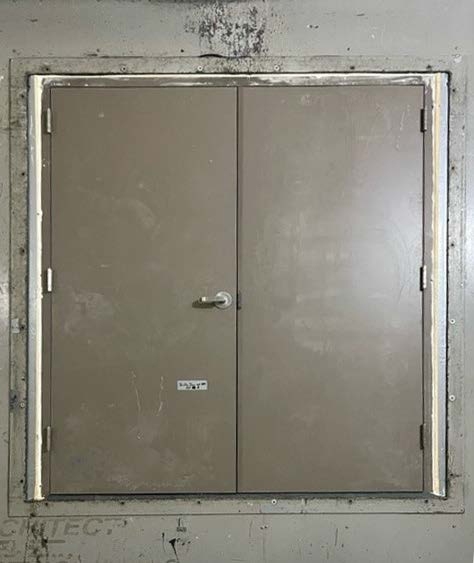



STC Rated Assemblies
SOUND TRANSMISSION CONTROL DOORS AND FRAMES
Acoustical performance of building materials is an important consideration for engineers, architects, specifiers and building owners, as door and frame assemblies play a key role in reducing the noise levels in and around highways, airports, highly populated residential areas, performing arts and band areas. Using the most advanced sound absorbing construction techniques and materials, Premier’s engineering team has designed one of the lightest weight acoustical door designs, with weights ranging from 150 lbs. (STC-48) to 210 lbs. (STC-50), our 1¾” doors will operate with the same force required to operate everyday hollow metal doors and frames.
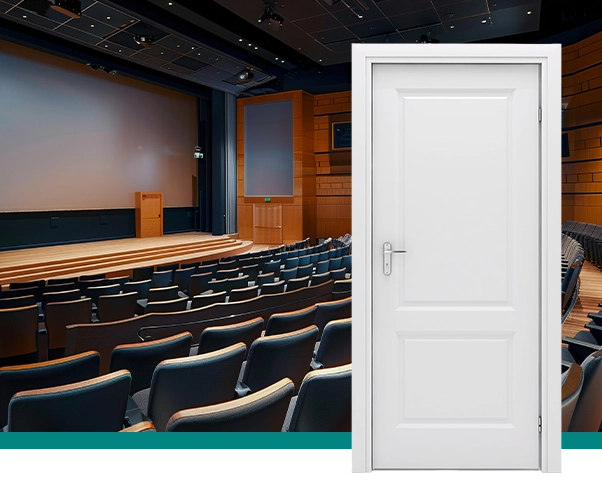
STC DOOR & FRAME FEATURES AND OPTIONS
Features and Options
- Singles up to STC 53
- Pairs up to STC 47
- Standard 5 3/4″ rabbeted frame up to 10 3/4″
- Standard 4 1/2″ hinges (Cam-Lift optional)
- Operable assemblies
- 1 3/4″ and 2 1/4″ Thickness Available Sizes
Available Sizes
- Up to 4080 (Singles) & 8080 (Pairs)
Material
- Galvannealed (A40)
Cores
- Proprietary acoustical cores
Special Options
- Hurricane Rated (Consult Factory for Size Limitations)
- Fire Rated up to 3 Hours 4080 (Single) & 8080 (Pairs)
Application
- Radio/TV/Audio Recording Studios
- Stage and Rehearsal Areas
- Convention Halls
- Auditoriums
- Music Practice Rooms
- Concert Halls
- Home Theaters
- Conference Rooms
- Secure Areas
- Sensitive Compartmented Information
- Facilities (SCIF)
- Offices and Executive Suites
- Doctors’ Offices – HIPAA Compliance
- Psychiatrist/Psychologist Offices
- Audiometric Exam Rooms
- Schools
SOUND RATINGS
TRANSMISSION LOSS (TL)
A door’s ability to reduce noise is called its transmission loss (TL) effectiveness. TL is a value given in decibels which is determined by measuring sound pressure levels at a certain frequency in the source and receiving rooms. The adjusted difference between the two levels is the TL of the door. The higher the TL, the better the result.
SOUND TRANSMISSION CLASS (STC)
TL measurements for a door are taken across a range of frequencies. Sound transmission class (STC) ratings give a value to acoustical performance for a door. STC is determined by a weighted average of TL values taken over 16 frequencies, which are fitted to a curve in a method defined by the ASTM E413 Classification Standard for Rating Sound Insulation. The higher the STC value, the better the rating and the better the performance.
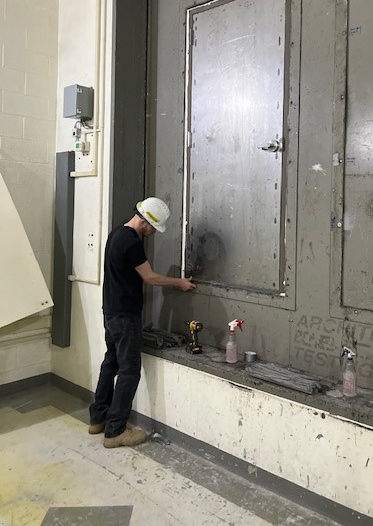
TESTING AND CERTIFICATION
Acoustical assemblies tested in accordance with the following:
- ASTM E90-09 (2016), Standard Test Method for Laboratory Measurement of Airborne Sound Transmission Loss of Building Partitions and Elements
- ASTM E413-22, Classification for Rating Sound Insulation
- ASTM E1332-22, Standard Classification for Rating Outdoor-Indoor Sound Attenuation
- ASTM E2235-04 (2020), Standard Test Method for Determination of Decay Rates for Use in Sound Insulation Test Methods